

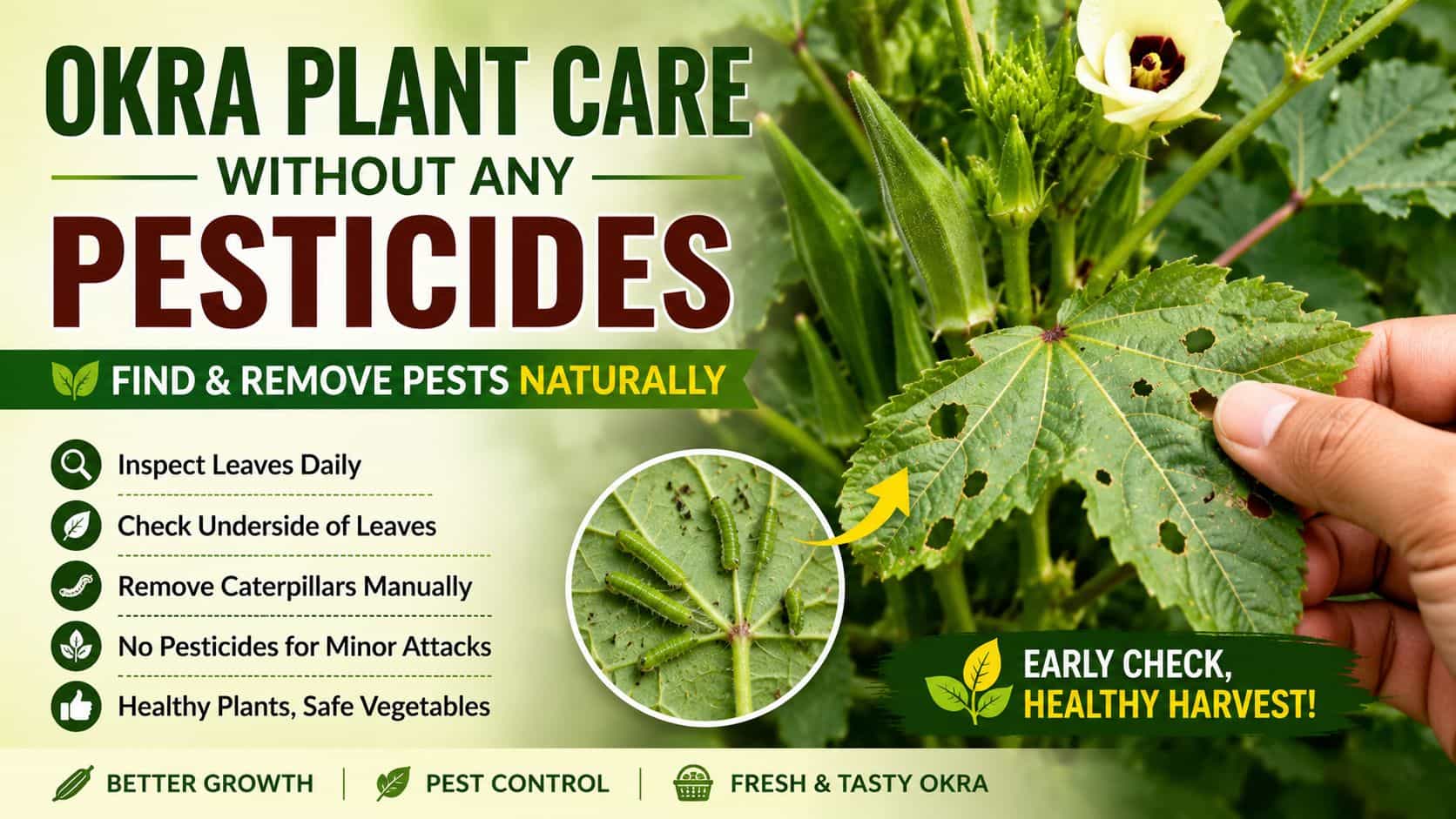
Growing a small number of okra plants at home makes it possible to inspect them regularly and control minor caterpillar attacks without immediately using pesticides. Early detection is the key.
By checking the leaves every day, especially their undersides, home gardeners can often find caterpillars before they cause serious damage. Small holes in leaves, chewed areas and caterpillar droppings are some of the signs worth watching for.
This method is particularly suitable for a small kitchen or terrace garden where every plant can be inspected individually.
Okra Plant Care – Quick Guide
| Details | Information |
|---|---|
| Crop | Okra / Lady’s Finger |
| Variety Used in This Experiment | Arka Anamika |
| Main Care Method | Regular inspection of plants |
| Areas to Check | Leaves, undersides, stems and new growth |
| Signs of Caterpillars | Small holes, chewed leaves and droppings |
| Minor Infestation | Find and manually remove caterpillars |
| Best Time to Inspect | Morning and evening |
| Pesticides | Not required for minor attacks controlled manually |
| Suitable For | Small home and terrace gardens |
| Limitation | Manual inspection may not be practical for large-scale cultivation |
Start with Good-Quality Okra Seeds
Good-quality seeds are important when starting an okra garden. Wherever possible, select fresh seeds from a reliable source and choose a variety suitable for your growing conditions.
I used the Arka Anamika variety for this particular cultivation experiment. The seeds were sown on September 25, 2018, and the plants reached the harvesting stage in around two months.
This should be treated as the result of that particular experiment rather than a fixed harvest period. Weather, variety, soil, sunlight, watering and nutrition can all affect the growth rate.
Check Your Okra Plants Every Day
Regular observation is one of the simplest ways to protect a small number of okra plants.
Take a few minutes every day to inspect the plants. Look at the upper and lower surfaces of the leaves, stems and tender new growth.
Caterpillars can remain hidden underneath leaves, so looking only at the visible upper surface may not be enough.
For a small home garden, this daily inspection can help identify a problem before the pest population becomes difficult to manage.
Small Holes in Okra Leaves Can Be an Early Warning
If previously healthy okra leaves suddenly develop small holes or chewed sections, inspect the plant carefully.
Leaf damage does not automatically identify a particular pest, so avoid treating every hole with a pesticide.
Instead, examine the affected leaf, its underside and nearby leaves to find out what is causing the damage.
If a caterpillar is responsible, it may be hiding close to the damaged area.
Look for Caterpillar Droppings
Another useful clue is the presence of small dark or greenish droppings on the leaves.
If you notice these around damaged areas, inspect nearby leaves carefully for caterpillars.
These signs can sometimes help locate a pest even when the caterpillar itself is initially difficult to see.
Remove Caterpillars Manually
When only a few okra plants are affected and the infestation is minor, caterpillars can often be picked off and removed manually.
Gloves can be used if preferred, or the caterpillar can be removed with a suitable small tool instead of touching it directly.
This method works best when the problem is detected early. Once a large number of pests become established, manual removal alone may not provide sufficient control.
Inspect Okra Plants in the Morning and Evening
Morning and evening are convenient times to inspect plants in a home garden.
You do not have to spend a long time checking every plant. Develop a routine of quickly examining the main leaves, their undersides, stems and tender growth.
Watch for new holes, chewed edges, droppings, curled leaves or visible insects.
Regular inspection also helps you become familiar with the normal appearance of your plants, making unusual changes easier to notice.
When Should Pest Control Be Considered?
For a small infestation, start with simple measures such as manual removal and continued monitoring rather than immediately applying a pesticide.
If the infestation becomes severe or continues to spread despite these measures, additional pest management may be necessary.
Correctly identify the pest before selecting any control product. Since okra is an edible crop, always follow the product label, recommended application rate and any required pre-harvest interval.
Why This Method Works Best for Small Home Gardens
Manual pest control is most practical when growing a limited number of okra plants for household use.
Inspecting ten or twenty plants regularly is very different from inspecting hundreds or thousands of plants in a commercial field.
For this reason, the method described here should not be considered a complete pest-management programme for large-scale okra cultivation.
It is primarily a simple approach for kitchen gardens, terrace gardens and other small growing spaces.
Can Okra Be Grown Without Pesticides?
It may be possible to manage minor pest problems in a small home garden without pesticide applications when infestations are detected early.
However, this does not mean that every okra crop can always be grown completely without pest-control products. Pest pressure varies according to location, season, weather and surrounding vegetation.
The practical approach is to observe the plants first, identify the problem and use only the level of intervention that is actually necessary.
For home gardeners, a few minutes spent inspecting okra leaves every day can make a significant difference. Finding and removing caterpillars early can help protect the plants while avoiding unnecessary pesticide applications.